Catholic Formation Today
The Method for TeensConfirmation Coordinator of 18 Years Reveals Why Teens Walk Away From the Faith Right After the Sacrament — and the Parenting Mistake That Speeds Up the Exit
Today
"Every year I confirm entire classes. And every year I see the same empty pews six months later. The worst part? What parents do at home only makes it happen faster."
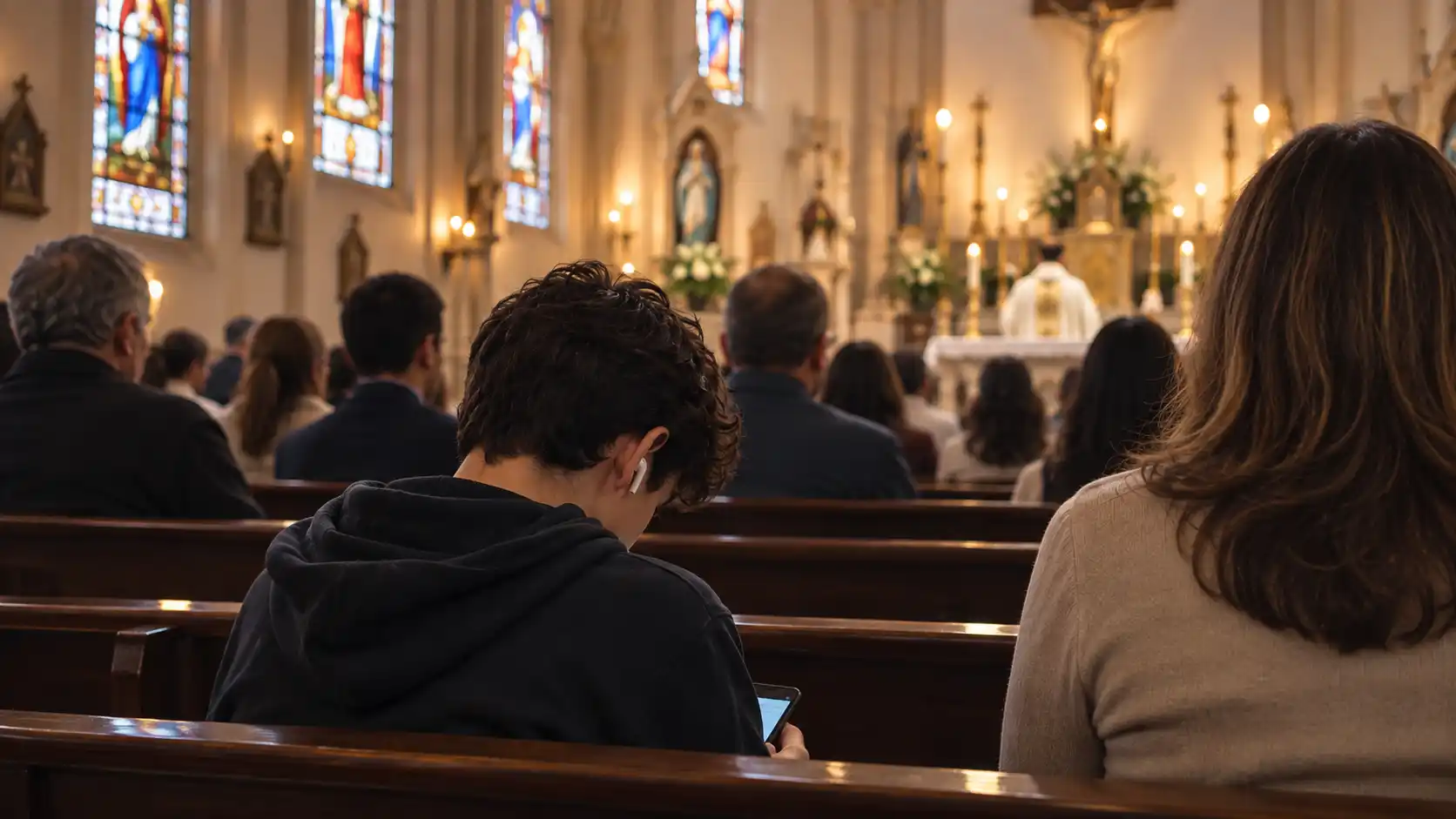
They Got Confirmed. And Then They Left.
If your teenager has ever asked whether they "have to" go to Mass…
If their answers about God have turned into "I don't know" and "whatever"…
If you can tell they're in the pew physically, but their mind is on their phone…
If you've ever caught yourself saying "as long as you live under my roof"…
Then what I'm about to tell you could change the next few years of your family's life.
According to the Pew Research Center, 41% of Americans raised Catholic no longer identify as Catholic. And here's the detail almost nobody tells parents: the decision to leave doesn't happen in college. It happens in the teen years — quietly, behind a closed bedroom door. College just makes it official.
But it isn't because of rebellion. Or the wrong friends.
It's the result of two mistakes that add up: a faith that was never given reasons… and the parents' instinctive reaction, which pushes at exactly the moment they should be pulling.
The Coordinator Who Got Tired of Watching the Pews Empty Out
My name is Helena. For 18 years I've coordinated Confirmation classes at my parish.
I've prepared more than 800 teenagers for the sacrament. I've organized retreats, trained catechists, and I know every objection a 15-year-old can come up with.
And there's one scene that repeats every single year — one it took me far too long to see.
Vitor was the best student in the 2022 class. Engaged, a lector at Mass, always ready with an answer. His Confirmation was beautiful — the whole family cried.
Six months later, his mother came to me in tears: "Helena, he doesn't want to go anymore. He says he's done his part. We fight every Sunday."
I asked her what she did when he refused. "We make him go, of course. As long as he lives here, he goes."
A year later, Vitor stopped going for good. And the last thing he said to his mother on the subject was: "Church is your thing. It was never mine."
What I Found When I Looked Up My Former Students
After Vitor, I did the research no coordinator wants to do: I looked up, on social media, the young people I had confirmed over the previous five years.
Out of every 10, I could barely find 3 who still practice the faith.
And the pattern that chilled me: the ones who left fastest were, by and large, the ones who were forced the most at home.
The strictest parents weren't keeping their kids in the Church. They were speeding up the exit — and paying for it with the relationship, too.
So I started studying. And what research on adolescent development shows explains everything.
The Second Window: Between 14 and 17, Inherited Faith Either Dies — or Becomes Their Own
Between ages 14 and 17, the teenage brain goes through a phase called individuation: it has to turn everything it received from its parents into its own choices — or throw it out.
Faith goes through that same filter. And here's the rule that changes everything:
Faith that's imposed feels like control — and teenagers reject control by instinct. Faith that's explained feels like truth — and truth, they respect.
When a parent says "you're going because I said so," they unknowingly confirm the teenager's worst suspicion: that there are no reasons. That it's just habit. That it's "your thing."
Vitor wasn't won over by atheism. He was handed over by the absence of reasons — with free shipping, courtesy of being forced.
Why What Parents Usually Do Doesn't Work
Force them? You win the Sunday and lose the kid. They sit in the pew and leave the Church on the inside, one Sunday at a time.
Lecture them? Teenagers have a built-in lecture detector. By minute three, the invisible earbuds are in.
Let it go completely? That's handing their formation over to TikTok, which answers the questions your family avoids — the wrong way.
Leave it to Confirmation class? A year of classes for a sacrament that, without reasons at home, turns into a graduation.
Meanwhile, the internet treats your child like an intellectual adult: it makes arguments, provokes, debates. The family answers with "because I said so."
Guess who wins their mind?
The Third Way: Don't Force, Don't Let Go — Convince
It was a dad from my Confirmation class who showed me the way out — by example.
His son was different. He enjoyed debating theology with the group. He brought a skeptical friend to a meeting. And his dad told me the secret:
"I stopped telling him to believe. I started showing him WHY it makes sense to believe. Teenagers don't obey an argument from authority — but they respect an argument from truth."
The material he used is called "The Why of Our Faith — Teen Edition": 52 weeks of Catholic formation designed for the mind of a 14- to 17-year-old.
It's not warmed-over catechism class. It's material that treats teenagers like the intellectual adults they're becoming:
• How we know God exists — the real arguments, no "just because."
• Science and faith — why the Big Bang theory was proposed by a Catholic priest.
• "The Church is full of hypocrites" — an honest answer to the #1 objection at this age.
• Why Mass isn't a waste of time — what's really happening there.
• Suffering, freedom, morality — the topics catechesis avoids and the internet gets wrong.
All faithful to the Catechism of the Catholic Church, with numbered citations. And structured as a DEBATE, not a lesson: every week ends with an open question to discuss at home — not an answer to swallow.
Why It Works With Teenagers
The method respects the stage they're in: individuation demands that the conclusion be THEIRS.
When a teenager reaches the answer through their own reasoning — guided, but not pushed — faith stops being an inheritance and becomes a conviction. And no 30-second video can take away a conviction that's truly their own.
Each week follows three steps: Question (the question they're already asking inside) → Discover (the arguments and evidence, presented as equals) → Debate (an open conversation at home, no lecture).
That's how their mind works at this age.
It's just that most families still talk to them like they're 8.
What Happened When I Tested It
I brought the material to 15 families from my Confirmation class — including three that were at open war with their kids over Mass.
Week 1: total skepticism (from the teens AND the parents).
Week 4: the first debates at the dinner table — about science and faith, with the kid ARGUING instead of rolling their eyes.
Week 8: a mom called me in tears: her son had answered a skeptical classmate at school. Calmly. With reasons.
Week 16: two teens in the group asked to bring friends to Confirmation. They asked. Nobody made them.
And the moment that made me agree to write this article: Vitor's mom, with her younger 14-year-old son, six months into the material. She told me: "Helena, he's downstairs ready for Mass before I am. I don't tell him anymore. He goes because he understands what happens there."
The Clock Parents of Teens Can't Ignore
With young kids, the window is wide open. With teenagers, it closes by decision — and that decision is being made right now, behind the bedroom door, one "whatever" at a time.
At 18, when they leave home or head off to college, whatever has been decided… is decided.
Every "you're going because I said so" Sunday is a push. Every unanswered question is a vote for leaving.
There's no neutral ground in the teen years. Either the faith becomes theirs — or it becomes "your thing."
The Decision That Determines the Outcome
You can keep up the tug-of-war every Sunday. Winning the arguments and losing your child, like Vitor's mom.
Or you can give your teenager what their age is demanding behind the apathy: reasons, respect, and room to reach their own conclusion.
"The Why of Our Faith" project is now making the Teen Edition available directly to families.
And, to reach as many families as possible, it's being offered at a special introductory price.
Confirmation coordinators are already using the material with their classes.
Catholic schools are bringing it into their high school programs.
You get the same 90-day guarantee that educators get.
If your teen doesn't engage, if you don't see a change, just ask for a refund.
But I've seen what happens when a teenager is finally treated like someone who thinks.
They don't abandon the material.
They ask if they can bring a friend.
Before "Whatever" Turns Into "Goodbye"
Every Sunday, well-meaning parents tighten their grip — and push.
Every Sunday, a teenager sits in the pew in body only and leaves the Church on the inside.
Every Sunday, another Confirmation gets one step closer to becoming a farewell.
Vitor is 18 now. His mother would give anything to go back three years.
You're still in those three years.
Don't let your child become the next Vitor.
The research is clear. The window is real. The third way works.
The only question is whether you'll trade the tug-of-war for real conversation before your teen's decision is made.
Still on the fence? Still betting that forcing them will work?
Vitor's mom made that bet too.
Helena
Confirmation Coordinator — 18 years forming teenagers in the faith
Finally telling the truth
"We fought EVERY Sunday. Now my 15-year-old is downstairs ready before I am. The difference? I stopped giving orders and started debating what the material brings up with him. He needed to be convinced, not forced."
"My son kept saying the Church is full of hypocrites. The answer from week 7 — 'the Church is a hospital, not a museum' — became HIS line. Teens adopt an argument when the argument is good."
"I'm a Confirmation coordinator and I've always watched the pews empty out after the sacrament. This is the first material I've seen teenagers take seriously — because it's the first one that takes teenagers seriously."
Click above to see if the Teen Edition is still available at the introductory price.